
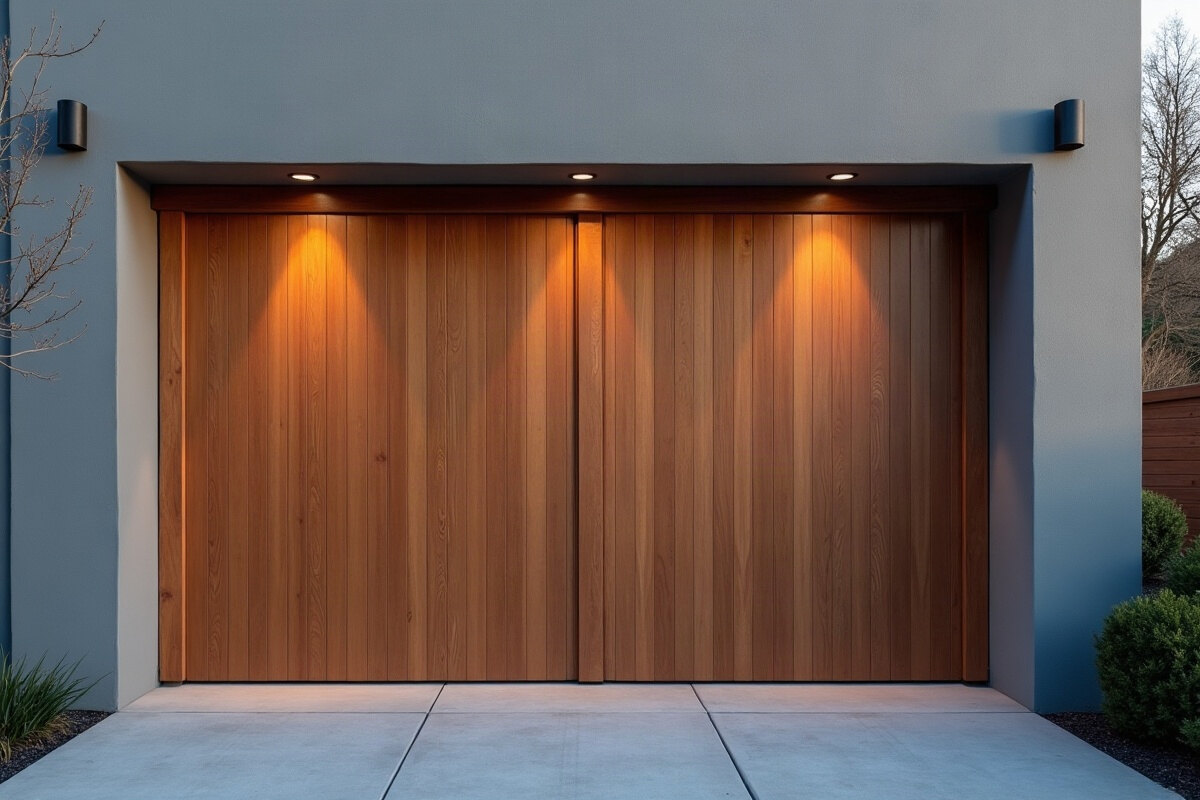
Seen from the street at dusk, the house reads as two volumes: a low board-formed concrete wing and, set flush within it, a single wide plane of vertical timber that turns out to be the garage door. It carries no windows, no raised panels and no hardware, only a fine shadow gap at its edges, and that restraint depends on a mechanism working quietly behind it, which is why a homeowner researching garage door repair Arlington tx is really looking after one of the largest moving surfaces on the facade.
A modern garage door succeeds when it disappears into the wall it belongs to and fails the moment it announces itself: a sagging section, a gap of daylight at the floor, a panel faded unevenly by the sun. The elements that decide which way it goes are few but exacting. The door face, the frame that receives it, the mechanism above, the floor it closes against, the weather it stands in and the light that falls on it each have to be resolved together, and each is read here in turn.
The Door Face
On a contemporary elevation the door is a wall that happens to move. The most convincing faces continue the cladding of the house around them, so that vertical timber boards, fiber-cement panels or a flat painted steel skin run straight across the opening with joints aligned to the courses beside it. A homeowner choosing a face is choosing between surfaces that weather in very different ways: timber silvers and checks slightly where the sun reaches it hardest, painted steel holds its color but shows every dent under raking light, and aluminum framing around frosted glass glows at night but reads as an object rather than a wall by day.
The refined result is the one where the joints between door sections fall on the same lines as the joints in the cladding, so the horizontal breaks a sectional door needs become part of the pattern rather than an interruption. An ordinary result treats the door as a product inserted into a hole; a careful one treats it as a panel of the facade that was always meant to lift.
The Frame and Reveal
Where the door meets the wall, the detail is everything. A reveal, the small recessed step between two surfaces, gives a flush door a clean edge and hides the inevitable small movements of a large panel. Too deep and the door looks sunk into a cave; too shallow and every slight misalignment shows. The jambs and head should be finished in the same material or color as the surrounding wall, so the eye reads one continuous plane broken only by a hairline of shadow.
Weatherstripping lives in this zone too, and it is where many minimal facades quietly lose their discipline. Seals that have hardened or torn let light, dust and insects through at the edges, and a bright line of interior light around a closed door at night is the clearest sign that the frame needs attention. Replacing seals is routine, though a bulky replacement profile undoes the reveal entirely.
The Mechanism Above
Behind the calm face sits the most heavily loaded equipment in most houses. Sectional doors ride on tracks and are balanced by springs wound under considerable tension, and that balance is what lets a heavy timber-clad door rise as if it weighed very little. When the balance drifts, the door begins to strain the opener, rise unevenly or settle with a thud, and those symptoms are worth taking seriously early.
Springs, cables and the brackets that hold them are not homeowner work. They store enough energy to cause serious injury, and adjusting or replacing them belongs to a trained technician with the right tools. What a homeowner can do is notice: a new grinding sound, a door that hesitates halfway, a cable that looks frayed, a gap that has opened on one side at the floor. A good garage door company will check the balance of the door, the condition of the springs and cables, the alignment of the tracks and the safety reversal of the opener, and explain plainly what it found before any work begins.
Heavier cladding also changes how a door must be balanced, so a new timber overlay should be discussed with the people who service the mechanism before it is fitted.
The Floor Line
The threshold of a garage is a meeting of two hard materials, and the best ones look inevitable. A driveway in broom-finished or exposed-aggregate concrete runs up to a slight fall at the opening, so water leaves the door rather than gathering against it, and the interior slab continues at nearly the same level. The bottom seal of the door closes against this line, and its fit is the most visible measure of whether the whole assembly is true.
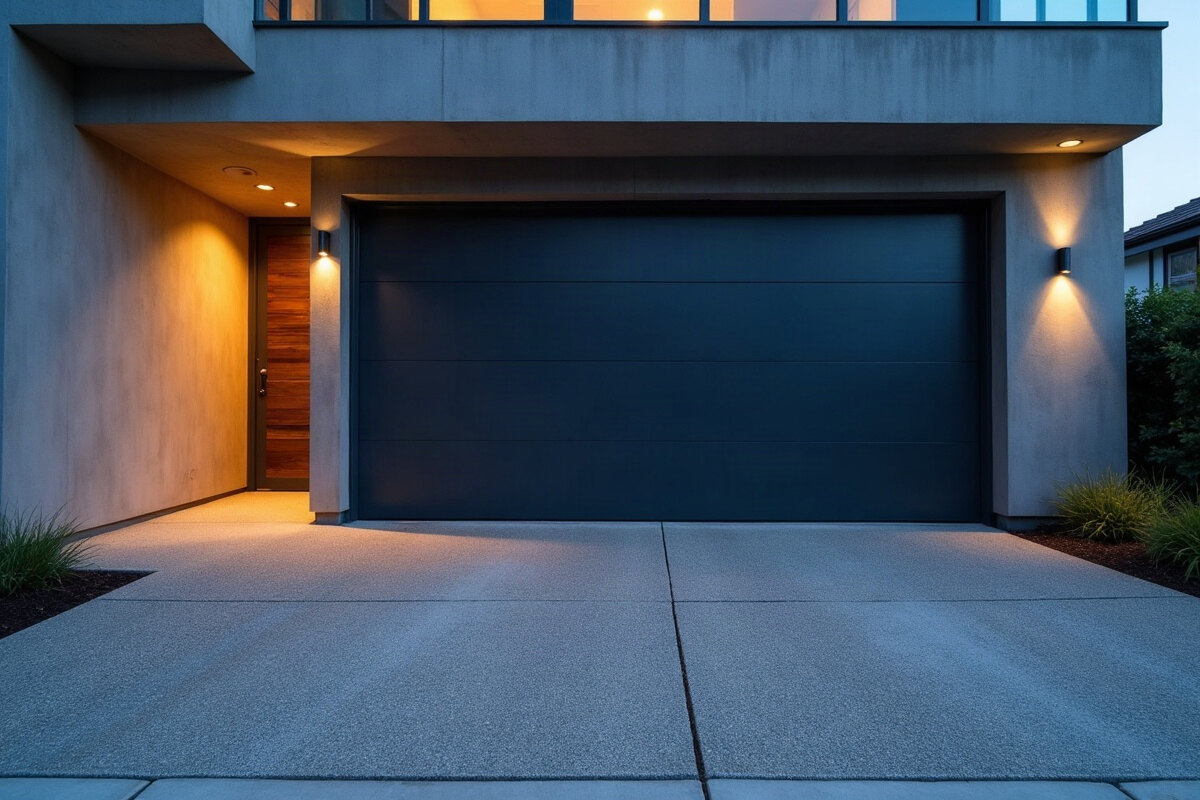
A seal that touches evenly from one side to the other means the door is square in its opening. One that leaves a wedge of light at a corner suggests the tracks, the balance or the slab itself has moved, and the cause is worth finding rather than masking with a thicker seal. Concrete in a region with expansive clay soils can shift slightly over the years, and a professional will distinguish between a door that needs adjusting and a floor that has moved beneath it.
Weather and Exposure
North Texas asks a great deal of an exterior surface. Long hot summers put intense sun on a south- or west-facing door for hours, spring storms can bring hail and driving rain, and the occasional hard freeze arrives with little warning. A large flat door takes all of this on a single face, which makes material choice and finish more important here than on a sheltered wall.
Timber faces benefit from a deep roof overhang or a recessed opening that keeps the worst of the afternoon sun and rain off them, and from a penetrating oil that can be renewed rather than a film finish that peels. Steel and aluminum faces should be inspected after a hailstorm, since small dents read clearly on a flat modern panel at low sun. Heat also affects the mechanism, drying lubricants and stiffening seals, so a yearly professional check sits comfortably alongside the routine care of the rest of the envelope.
Light
Daylight
A flush garage door on a modern facade is read largely by the light that rakes across it. Morning sun from the side exposes every undulation in a steel skin, while the soft light of an overcast day flattens timber into a single warm tone. Designers often set the door slightly back from the main wall plane so that a shadow line falls across its head for much of the day, giving it depth without any added ornament.
Artificial Light
At night the garage elevation is often the first thing a visitor sees, and harsh wall lights on either side of the door flatten it into an opening. The calmer approach is a concealed linear light set into the soffit or the head of the reveal, washing down the face so the grain of timber or the texture of a painted panel becomes visible, with the driveway lit low and evenly rather than floodlit.
Material Palette
- Door face: vertical cedar or thermally modified timber in a penetrating oil, chosen because it continues the cladding and silvers evenly where the sun reaches it.
- Surrounding wall: board-formed concrete, which gives the door a heavy, still frame and darkens only slightly after rain before drying back to gray.
- Reveal and jambs: powder-coated aluminum in a matte charcoal, because it holds a crisp edge and hides the small shadows of a moving panel.
- Driveway: exposed-aggregate concrete, which offers grip in wet weather and wears into a softer texture rather than showing scuffs.
- Interior slab: sealed, lightly polished concrete, chosen because it carries the exterior plane inside and wipes clean of road dust.
- Seals: flexible rubber gaskets in black, which stay out of sight in the shadow gap and are simple to renew when they harden with age.
- Soffit: smooth exterior plaster in a pale warm white, which reflects the concealed light down onto the door and ages to a quiet patina.
How It Comes Together
The modern garage door is held together by alignment and by care. The face continues the wall, the reveal draws a single fine line around it, the floor meets it squarely, and the hidden mechanism keeps all of that true each time the panel lifts. When any one of these slips, the facade loses the stillness it was designed around, and the fix is usually a matter of attention rather than replacement.
A garage door that moves without a sound and closes into a perfect shadow line is the clearest sign of a house that is looked after as well as it was designed.