
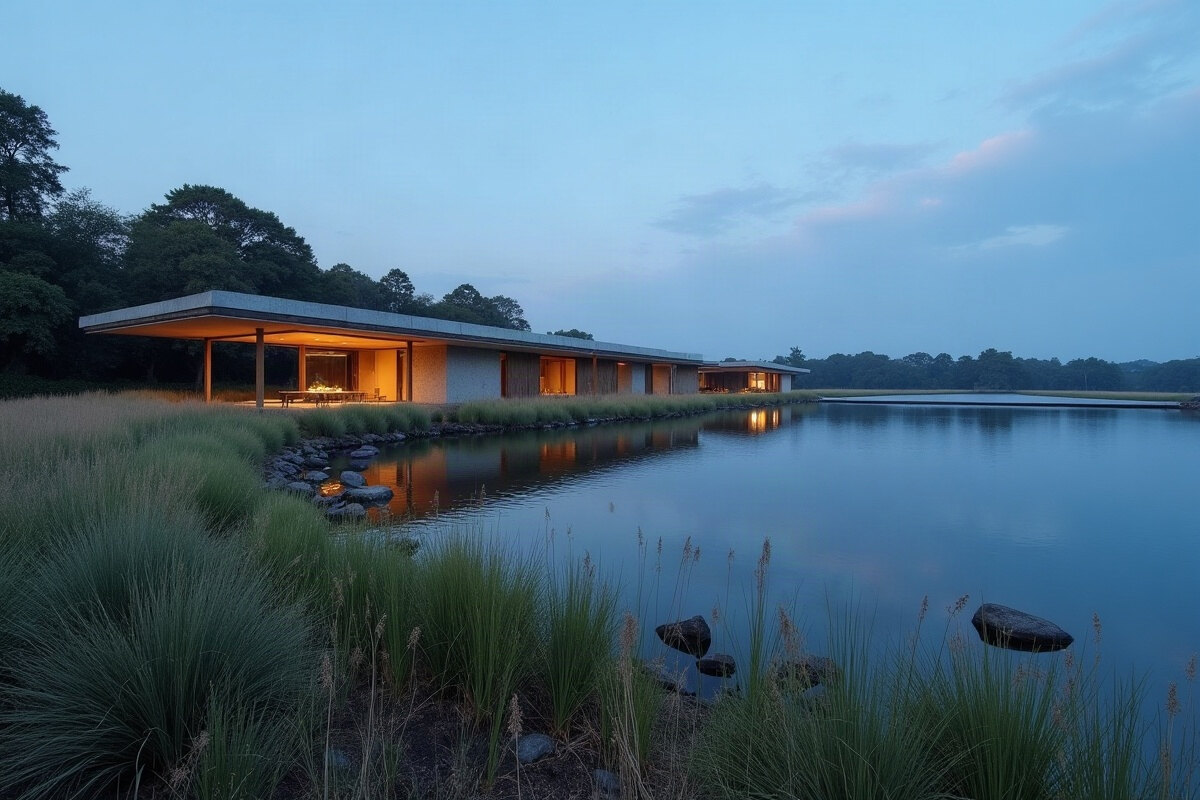
At dusk the lagoon is the brightest surface on the site. A long, flat sheet of water holds the last of the sky, a low pavilion sits along one edge with its roof pulled far out over a shaded deck, and a line of swell moves across the pool with a regularity no ocean offers.
The surf park Fellsmere FL visitors head inland to reach belongs to a building type that architecture has barely begun to describe. A wave pool is landscape, machine and building at once, and it succeeds or fails on how it handles sun, heat and water. In a subtropical climate, every decision is a climate decision. The anatomy below reads such a place element by element, from the ground to the services hidden beneath it.
The Site
A surf lagoon is, first, a very large horizontal object. It flattens the site around it and sets the dominant line of every view, so the buildings that serve it work best when they stay low and long, echoing the water rather than competing with it. A tall clubhouse would cast shade where no one wants it and break the open horizon that makes the lagoon read as a coastline.
Orientation is the quiet decision with the largest consequences. The prevailing wind, the path of the afternoon sun and the line of sight from the deck all bear on where the pavilion sits and which way its open side faces. A refined plan puts the viewing terraces where the low western sun falls behind the spectator rather than in their eyes, and lets the breeze cross the deck instead of being blocked by a solid wall.
Water
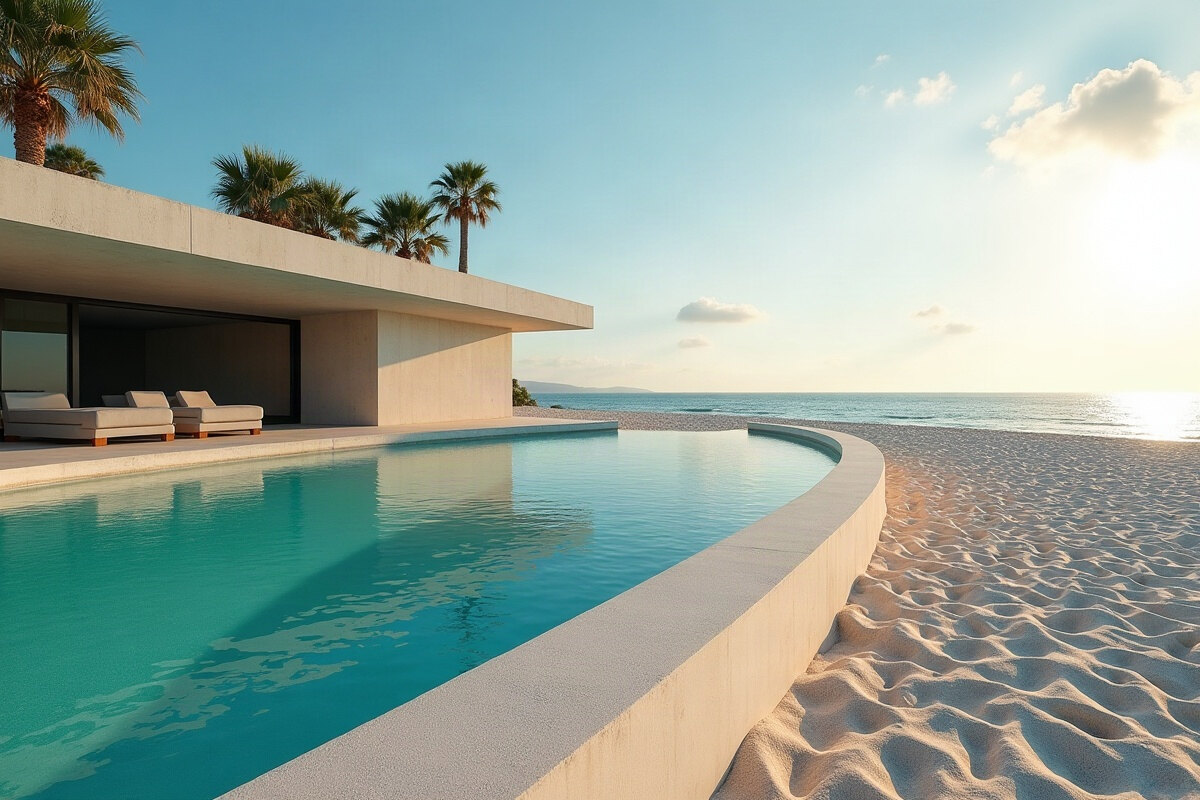
The lagoon is the reason for everything else, and its edges deserve the attention a designer would give to a reflecting pool. A hard edge of concrete coping reads as architecture, crisp and geometric; a graded edge that slopes into the water reads as a beach and invites people in. Most parks of this kind use both, with hard edges near the buildings and soft ones where riders enter and leave the water.
Water in a hot climate also does climatic work. A broad surface cools the air that passes over it a little through evaporation, and the reflected light brightens the underside of any roof nearby. Those effects are welcome on a terrace and unwelcome indoors, which is why the better buildings keep large glazed walls in the shade rather than facing the glare off the water directly.
Shade
In a place of strong, high sun, shade is the primary building material. The most successful pavilions treat the roof as a parasol: a broad, thin plane lifted on slender columns, its overhang deep enough to keep the deck in shadow for most of the day. Below it, walls become optional, and the building can open fully to the breeze.
The choices available run from solid roofs to perforated canopies, timber louvers and tensioned fabric. Solid roofs give the deepest shade and the best shelter from sudden summer downpours; louvers and perforated screens filter the light into moving patterns that change through the afternoon. Color matters as much as form: pale roof undersides bounce soft light back down onto the deck, while dark ones absorb heat and radiate it onto the people sitting beneath. What separates a refined result from an ordinary one is coherence, a single shading language used across the site, rather than a different umbrella, awning and pergola at every corner.
Wind and Storms
A deep, thin roof is also a sail. On a coast exposed to tropical storms, broad canopies need structure and fixings designed by engineers for the wind loads of the region, and any building permit question belongs with the local building department. None of that should show in the finished work: the best canopies look weightless precisely because their strength is resolved in connections the eye never reads.
The Envelope
Where the pavilion does enclose rooms, such as changing areas, a café or a retail counter, the envelope has to handle heat and humidity at the same time. Glass is the hardest material to manage here. Large glazing facing the lagoon brings in the view and, unshaded, a great deal of solar heat, so it works best recessed behind the roof’s overhang or protected by vertical fins on the low-sun sides.
Humidity is the less visible adversary. Warm, wet air meeting cooled interior surfaces leaves condensation inside walls, where it feeds mold and rot. A careful envelope keeps the vapor control, insulation and air sealing continuous, so the cool side of every wall stays dry. Materials that tolerate moisture, such as mineral boards, treated timber and sealed concrete, belong in the wet zones near the water, where changing rooms and showers add their own steam to the climate outside. It is invisible work, and in a subtropical building it decides whether the finishes last a decade or a few seasons.
Hidden Services
A wave pool is one of the most service-heavy landscapes in architecture. Somewhere below or beside the lagoon sit the systems that make the waves, filter and treat the water, and keep it circulating. The design question is where all of that goes, because exposed plant rooms, pipe runs and equipment yards undo the calm of the water faster than any other element.
The refined approach treats services as a building in their own right, often half-buried and roofed with planting so that the machine room reads as a berm in the landscape. Air conditioning for the enclosed rooms follows the same logic: condensing units grouped and screened, ducts concealed in the roof depth, supply air delivered through slim linear slots rather than bulky grilles. Visitors should see water, roof and sky, and never the hardware that keeps them in order.
Light
Daylight
The day on a lagoon runs through distinct moods. Morning light is low and soft and arrives across the water from the east; midday light is nearly vertical, flattening shadows and turning the surface white with glare; late afternoon light rakes the swell and throws long shadows from every column. A well-placed pavilion gives each period a place to be enjoyed, with an east terrace for the early hours and a deep, shaded west deck for the end of the day.
Artificial Light
After dark, the lagoon becomes a mirror for whatever light surrounds it. Restraint pays: low, shielded fittings along paths, warm light under the roof plane, and underwater lighting kept soft enough that the pool glows rather than blazes. Bright floodlights on tall poles flatten the scene and spill light into the night sky, while concealed, warm sources let the water carry the composition.
Material Palette
- Lagoon edge: board-formed concrete coping with a light broom texture, because it reads as architecture near the buildings and stays sure-footed when wet.
- Roof underside: pale timber battens, because they warm the reflected light from the water and hide the services above.
- Deck: large-format porcelain in a textured exterior finish, because it stays cooler in color than dark stone and resists salt and chlorine.
- Screens: vertical timber or aluminum fins on the low-sun sides, because they cut heat gain while keeping the view.
- Glazing: high-performance glass recessed under the overhang, because shade, not tint, is the best protection against glare.
- Landscape: native grasses and palms in sandy beds, because they belong to the climate and need little more than the rain provides.
How It Comes Together
A wave pool landscape holds together when every part answers the same climate. The roof shades, the water cools and reflects, the envelope keeps humidity out of the walls, and the services sink into the ground so that the horizon stays clean. None of those elements is visible as a system; the visitor only notices that the deck is comfortable at midday and the view is uninterrupted at dusk.
The best inland surf parks will be judged less as attractions than as landscapes, and the ones that endure will be those that treated shade, water and hidden services as the architecture itself.